Most yard advice is written for a southern Australian year. Brisbane runs on a different calendar, and 93 years of local weather data makes it clear where the turning points actually are.
The short version
- At Archerfield Airport the mean overnight minimum runs 20.5 degrees in January and 7.8 in July, while the 3pm reading only moves from 28.8 to 20.2. Mild afternoons, cold nights.
- December to March carries the growth: 156.3 mm of rain in February alone, on 9.8 rain days. Keep the interval tight and do not hard prune.
- April and May are the driest workable weeks, the best window for bigger jobs that need equipment on a lawn.
- June to September the lawn all but stops. September is the driest month at 34.6 mm. Cut less, cut higher, and do the structural work instead.
- October is the hinge: rain doubles to 79.0 mm and nights warm to 14.6 degrees. Work done then is worth more than the same work done later.
The year has two halves and one hinge
Most yard advice is written for a climate that is not this one. It talks about spring growth and a dormant winter, which is a southern Australian year. Brisbane does something different, and the numbers make it obvious.
Take the record at Archerfield Airport, station 040211, where the Bureau of Meteorology has 93 years of rainfall. The mean overnight minimum runs from 20.5 degrees in January down to 7.8 degrees in July. The mean 3pm reading only moves from 28.8 to 20.2 across the same span. Our winter afternoons are mild. Our winter nights are not.
That gap is what drives everything below. Warm season grass responds to the cool night far more than to the mild afternoon, so the lawn slows down while the weather still feels pleasant to work in.
December to March: keep up or fall behind
This is the quarter that decides how the yard looks for the rest of the year.
Rainfall runs 125.0 mm in December, 134.6 in January, 156.3 in February and 133.8 in March, on 8.8, 9.0, 9.8 and 10.0 rain days respectively. Overnight minimums sit between 18.6 and 20.5 degrees. Warm, wet and constant, which is the exact recipe for growth.
What to actually do
Cut short and often. The interval matters far more than anything else you could do in these months, and stretching it is what creates every problem that follows. Our lawn mowing schedules tighten right up through here for that reason.
Keep the edges in. They run faster than the lawn because they pick up water off the path and driveway, and a lost edge is what makes an otherwise tidy yard read as neglected.
Expect the fortnightly green bin to be full. Ten rain days in March means the grass never dries out enough to slow down, and the volume coming off a weekly cut in that month is more than a fortnightly bin can absorb.
What not to bother with
Do not hard prune anything. A shrub cut back hard in February will push soft, sappy growth straight into the wettest weeks of the year, which is when fungal problems are easiest to pick up. Shaping is fine. Structural cutting can wait.
April and May: the easiest weeks of the year
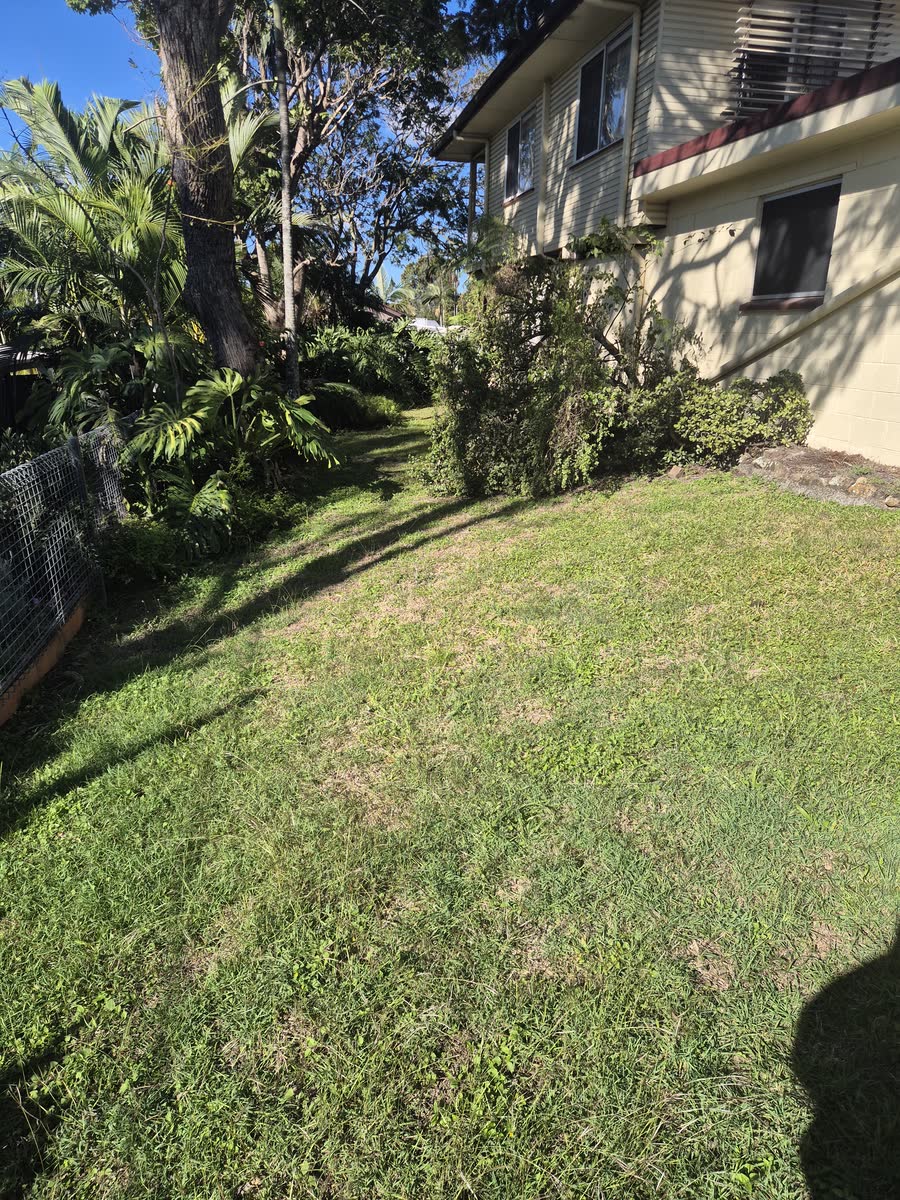
Rainfall drops to 77.2 mm in April and 73.2 in May, and rain days fall from 10.0 in March to 6.5 in May. Overnight minimums come off 18.6 degrees in March to 12.0 in May.
Growth slows but has not stopped, and the ground is drying out. For anything that involves getting equipment onto a lawn without leaving marks, or working in a garden bed without compacting wet soil, this is the best window in the calendar.
It is the sensible time for the bigger jobs: a bed reshaped, an overgrown corner brought back, a hedge given its proper cut rather than a tidy. That kind of garden maintenance is far less disruptive now than it is in either the wet or the depths of winter.
June to September: stop doing so much
Here is where most people waste money.
July averages 47.2 mm of rain across just 4.5 rain days, August 35.6 mm and September 34.6 mm. September is the driest month on the record. Overnight minimums bottom out at 7.8 degrees in July. The lawn is barely growing.
Cut less, and cut higher
A three to four week interval is usually right through this stretch, and taking less off each time matters more than usual. The lawn is not replacing what you remove at any speed, so anything cut hard in July still looks bare in September.
This is also the point where a fixed year round contract quietly stops being good value. If you are paying for a weekly cut in July, you are paying for a service the lawn cannot use.
Do the structural work instead
What winter is good for is everything that is not the lawn. Deciduous and woody material can be cut back properly while it is not pushing growth, weeds are slow enough to actually get on top of, and a full clean up done now is still visible in October rather than being swallowed by regrowth in a fortnight.
Winter is when we do most of the heavy hedge trimming, for exactly that reason.
Watering follows the same curve
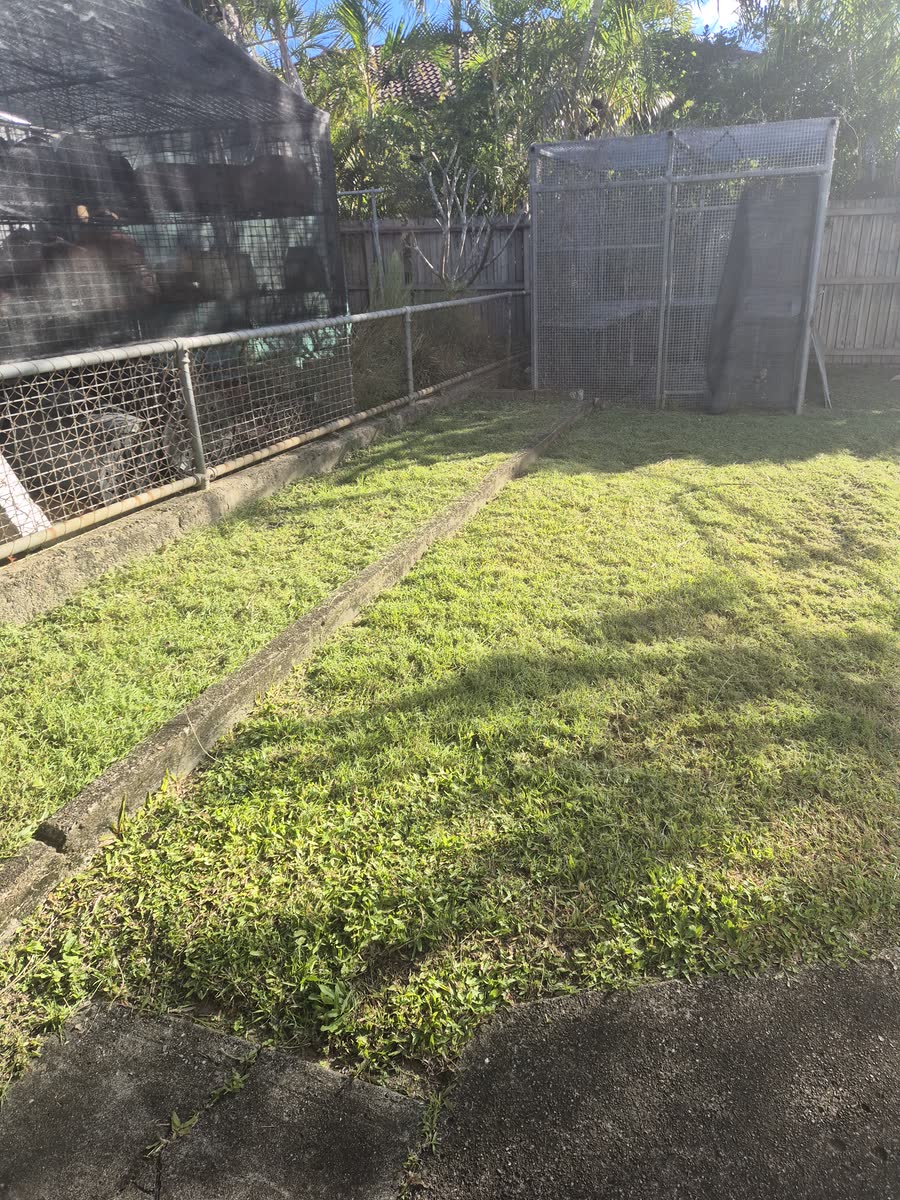
The rain days figure is the one to watch here rather than the millimetre total. March averages 10.0 days of rain and August 4.0. A lawn getting natural water every third day in March is getting it every seventh or eighth in August, and that is the difference that shows up as stress long before anyone thinks to look at a rain gauge.
It also explains why lawns brown off in late winter in a month with barely any heat in it. It is not the temperature doing that. It is 34.6 mm across four days, four months into a dry run.
The two mistakes that cost the most
Across a lot of yards in Brisbane's south, the same two decisions cause most of the damage, and both come from applying a calendar that belongs somewhere else.
Hard pruning at the wrong end of the year
Cutting a hedge or a shrub back hard in the middle of the wet forces soft growth out in the most humid weeks of the year. Doing the same cut in winter, when the plant is not pushing, lets it hold the shape until spring and then fill it out properly. Same cut, opposite result, entirely because of the month.
Paying a flat rate all year
A flat weekly or fortnightly rate looks tidy on paper and it is wrong in both directions. It underserves the yard from December to March, when it needs more, and it overcharges from June to September, when the grass is barely moving. The yard gets worse and it costs more, which is a difficult combination to defend.
There is a third, quieter one: treating the whole yard as a single job. The lawn, the edges, the beds and the hedges are all on different clocks, and a visit that does the lawn well in February while the hedge quietly gets away is how a yard ends up needing a full reset every couple of years instead of just being maintained.
Splitting them out is not more expensive. It usually costs less, because each piece gets done at the point in the year when it takes the least effort, rather than everything being attempted at once in whichever month somebody finally noticed.
October: the hinge
If there is one month to pay attention to, it is this one.
Rainfall roughly doubles from 34.6 mm in September to 79.0 mm in October, then goes to 100.3 in November. Rain days climb from 4.2 to 6.7 to 7.7. The overnight minimum moves from 11.3 degrees in September to 14.6 in October and 17.3 in November.
Everything switches on at once. The lawn that has been sitting still since May starts moving, the weeds that were slow become fast, and the hedges begin putting on the growth that will need managing all summer.
Work done in October is worth more than the same work done at any other time, because it sets the shape that the growing season then fills out. Work left until December is catch up, and catch up always costs more.
A note on when the mower can actually run
One practical constraint sits over all of this. Brisbane City Council noise standards set the hours for power tools and garden equipment, and they rule out the early starts and late finishes that people sometimes ask for.
It matters most in summer, when the days are long enough that it feels like a job could start at six. It cannot. That shapes how many properties fit into a day, which in turn shapes how tight a schedule can realistically be across Carindale, Mount Gravatt, Upper Mount Gravatt and Sunnybank.
Where to start
If you take one thing from the numbers: the yard needs roughly three times as much attention in February as it does in July, and the month that decides how the whole summer goes is October.
The other thing worth saying plainly is that none of this needs a specialist to work out. The Bureau publishes the whole record for Archerfield free, and anyone can read the monthly columns and see where their own yard is going to demand attention. What a schedule buys you is somebody actually turning up in the weeks that matter, rather than in the weeks that happened to be convenient.
A schedule built around that costs less across a year than a flat one, because the winter visits drop away, and the yard never has the bad stretch that comes from falling behind in the wet. If you want yours set up that way, get in touch or have a look at what we cover on the services page.